Restoration of Bartholomew
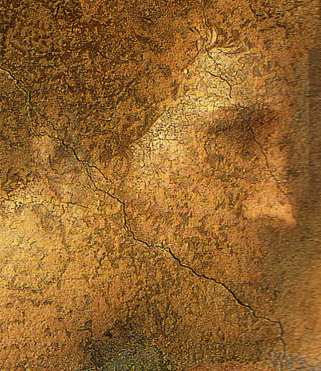
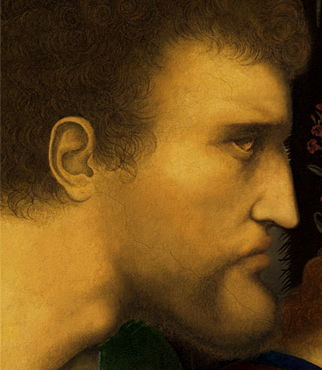
Bartholomew's head original
Head of Bartholomew, reconstruction
Brush strokes of hair
The original head of Bartholomew still has a small amount of hair painted with sharp brushstrokes remaining. This is a valuable vestige, as it is extremely rare for hair to remain in the current Last Supper.
Leonardo is famous for his sfumato, but in his drawing for the Virgin and Child with St. Anne, housed in the National Gallery in London, commonly known as the Calton at Burlington House, countless powerful, sharp brushstrokes remain, and the sense of speed of his brushwork is overwhelming.
The traces of Bartholomew's hair suggest that such fast, sharp brushstrokes were used to paint the hair of the apostles in the Last Supper.
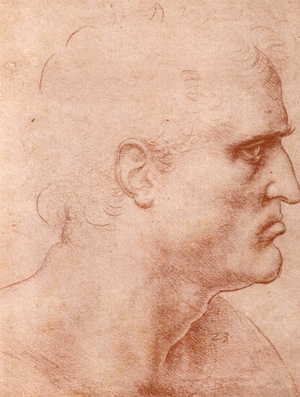 Drawings of Bartholomew
In the drawing of Bartholomew, the beard and hair are omitted.
This is a feature that can also be seen in the drawings of Simon and Judas, and it seems that this was a basic habit of Leonardo's in the drawing stage.
In Leonardo's time, paper was an expensive art material, and not something that was available everywhere.
It was also complicated to handle, and it was common to take the trouble to prime the paper surface to make it easier for the art material to adhere to it before using it. Drawing with chalk on this paper was probably the latest trend that was becoming popular among artists of the time.
Leonardo also used pen and ink on paper a lot in the early stages of his work, and it was during his time in Milan that he began to use chalk.
Comparison of Bartholomew's drawing and the original
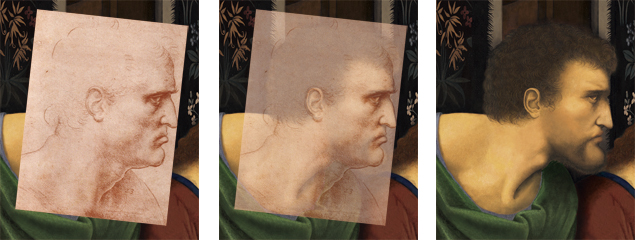
As you can see from the above image, the sketch was not used as is for The Last Supper. The biggest difference is the depiction of the shoulders behind the neck.
In the sketch, the figure is depicted almost upright, but in the mural, Bartholomew is depicted leaning forward slightly, which causes a big discrepancy in the depiction of the shoulders.
This unique Leonardo production process, that is, the method of determining the rough pose and composition in a sketch and then preparing the detailed sketch, is seen in almost all of his works and is a regular method of Leonardo.
These production processes are also described in Leonardo's notes on painting, and are like a philosophy of Leonardo's painting.
However, in my personal opinion, I feel that this is Leonardo's biggest weakness.
Leonardo was not very good at drawing shoulders, and there are many depictions that show anatomical inconsistencies.
This can even be seen in Leonardo's masterpieces such as the Mona Lisa and the Virgin and Child with St. Anne. Specifically, Leonardo had a habit of drawing shoulders with a large arch, which I feel makes them too large and round.
It's not that Leonardo lacked drawing skills, but rather that he simply drew people based on ideas and concepts.
These are both flaws and individuality. If these flaws were corrected, Leonardo's works may end up seeming somewhat ordinary, uninspired, and boring.
Bartholomew Restoration Process
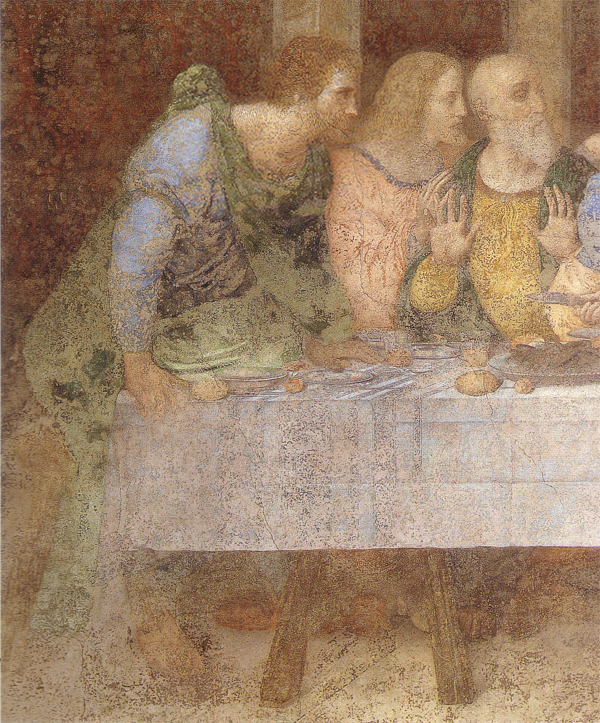
Left: Condition of the original painting
The upper half of Bartholomew's body still has a good amount of the drawing layer remaining compared to James the Younger next to it. However, the lower half of the body is in an almost hopeless state.
The condition of the painting below this table is always catastrophic, with almost no drawing layer remaining on the lower halves of any of the apostles' bodies.
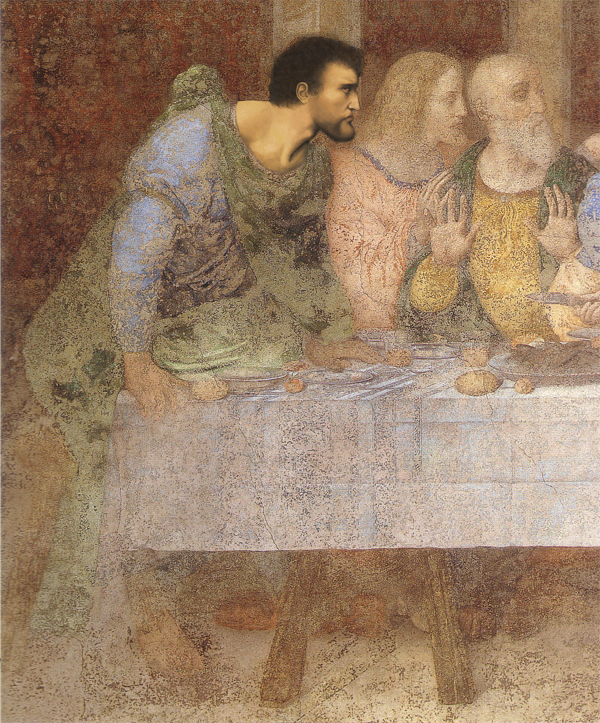 Recent restorations have confirmed that brown pigments were used to depict Bartholomew's hair.
It is certainly possible that the hair was painted a lighter brown color.
However, I have restored this part using the dark brown, close to black, seen in Giampietrino's copy.
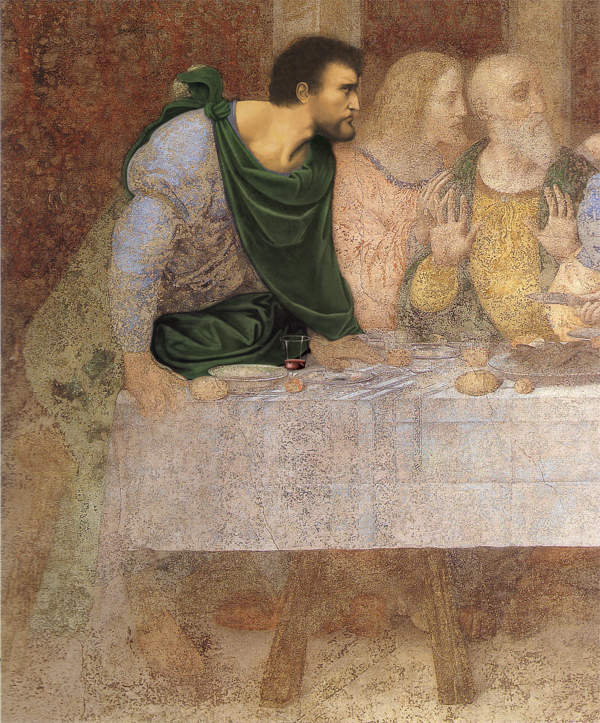 When restoring Bartholomew's green cloak, the depiction of the angel's cloak in the Virgin of the Rocks was extremely helpful.
There are particularly useful tips for handling highlights, and for bringing out the luster and texture of the fabric.
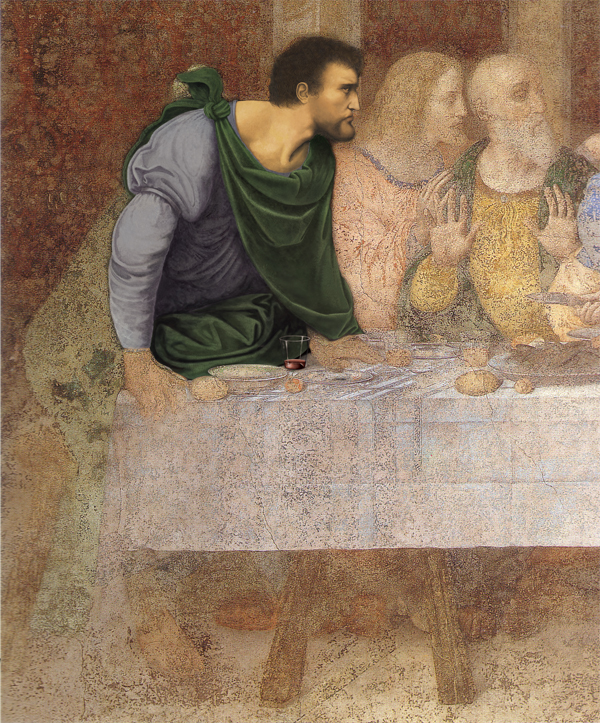 The restoration of Bartholomew's light blue clothing will generally follow the depiction in Giampietrino's reproduction painting.
However, the abdomen area is in shadow, and the detailed shape of the garment's folds cannot be made out, so the restoration of this area will prioritize the traces remaining in the original painting.
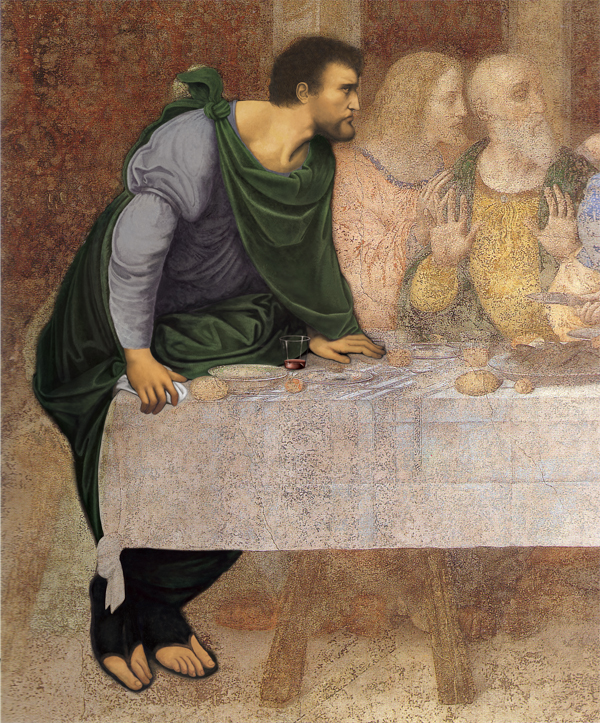 Left: Completion of Bartholomew
A red chalk drawing of Bartholomew's left hand, presumably prepared by Leonardo, remains in the Windsor Castle collection.
The extremely accurate drawing suggests that it may have been drawn using an actual model.
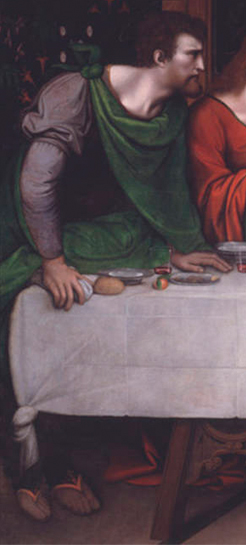
The right hand cannot be seen in the original mural, but in the replica it can be seen that he is holding a white cloth.
Furthermore, the original painting of Leonardo's feet under the table barely retains the layer of drawing that Leonardo did, so it is not even possible to identify the position of the feet.
The existence of a replica is essential for restoration.
The right foot is depicted in almost the same position in both the Vatican tapestry and Giampietrino's replica.
However, the decoration of the sandals shows unique patterns in both cases, so it is necessary to compare the depictions of other replicas to decide which one to use.
The most distinctive feature of Bartholomew's feet is that his left foot is crossed in front of his right foot.
At first, I did not understand why his feet were crossed, so I had a lot of trouble figuring out the position of Bartholomew's feet.
Comparison with major reproductions
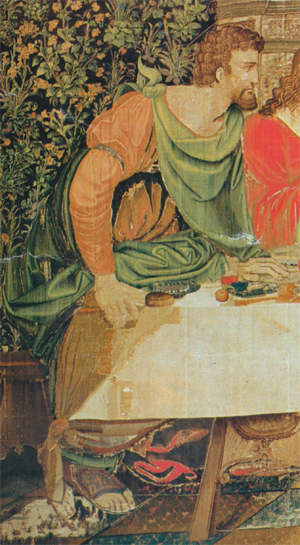
Vatican Tapestry
Giampietrino's reproduction
http://leonardoresearch.jp/ August 17 2014

leonardoresearch.jp